
Salon content marketing is the strategic practice of creating and distributing valuable, targeted content to attract ideal clients, build trust, and convert interest into booked appointments. Unlike running a Google Ad or posting a before-and-after photo, content marketing works by answering the questions your future clients are already searching for. Google Business Profile updates, Instagram service guides, blog posts, and booking prompts all fall under this umbrella. GBP listings with 100+ photos receive 520% more calls than those with fewer than 10. That single stat shows how much content volume and quality shape real business outcomes for salons.
What is salon content marketing and why does it matter?
Salon content marketing is the industry term for what marketers call content-led demand generation applied to local service businesses. The goal is not just visibility. The goal is trust, and trust converts into appointments.
Most salon owners already create content. The problem is that brand presence differs from content marketing in both purpose and execution. Posting a photo of a balayage result shows what you can do. Writing a guide titled “How to Maintain Balayage Between Appointments” answers what your client actually needs to know before she books. One builds a portfolio. The other builds a relationship.

Content marketing for salons also compounds over time. A blog post ranking on Google for “best keratin treatment in Austin” keeps driving traffic for months or years. An Instagram post from last Tuesday is invisible by Friday. That difference in shelf life is why website content delivers lasting ROI while social posts remain ephemeral. Both have a role, but only one builds a durable asset.
Content marketing vs. social media posting: what’s the real difference?
The confusion between content marketing and social media posting costs salon owners real money. Social media posting is a distribution tactic. Content marketing is a strategy with a defined goal: move a potential client from “I’ve heard of this salon” to “I just booked an appointment.”
Effective salon digital marketing strategies use content to answer pre-booking questions. Think about what your clients ask before they commit: “Will this color damage my hair?” “How long does a Brazilian blowout last?” “What should I do the night before my appointment?” Every one of those questions is a content opportunity. A salon that answers them on its website or YouTube channel wins the booking before a competitor even enters the picture.
Here are the content types that consistently drive pre-booking trust for salons:
- Service explainer pages that describe what a treatment involves, how long it takes, and what results to expect
- Blog posts targeting local search terms like “best highlights salon in [city]”
- FAQ videos on Instagram Reels or YouTube Shorts addressing common client concerns
- Email sequences that educate new subscribers before asking them to book
- Google Business Profile posts that highlight seasonal services with direct booking links
Pro Tip: Write one blog post per month targeting a question your front desk hears repeatedly. Over 12 months, you will have a library of content that ranks on Google and answers client objections before they even call.
What are the three content pillars every salon needs?
The most reliable framework for content marketing for salons is the 40-40-20 model. It divides your content output into three pillars: Proof, Education, and Ask. This ratio consistently outperforms random posting because it mirrors the actual psychology of a client’s decision process.
Here is how the three pillars break down:
-
Proof (40%): Before-and-after photos, client testimonials, transformation videos, and portfolio posts. This content demonstrates your skill and builds credibility. Post these on Instagram, Google Business Profile, and your website gallery.
-
Education (40%): How-to guides, product recommendations, treatment explainers, and seasonal hair care tips. This content answers questions and positions you as the expert. Blog posts and Instagram carousels work especially well here.
-
Ask (20%): Direct calls to action tied to a specific offer, time window, or availability. “Book your summer color refresh before July 4th” outperforms “DM me to book” every time. Clear, time-bound CTAs convert significantly more than vague ones.
The Ask pillar is where most salons fail. They create beautiful proof content and genuinely helpful education content, then forget to tell anyone to book. Every piece of content needs a next step, even if it is just a link in your bio.
How should salons distribute content across digital channels?
Channel selection determines whether your content reaches the right people or disappears into the void. Consistent multi-channel marketing starting with Google Business Profile and Instagram builds the strongest foundation for most salons. Start with two or three channels and do them well before expanding.
Here is a practical channel breakdown for salon owners:
- Google Business Profile: Post weekly updates, add new photos consistently, and respond to every review. This directly impacts local search rankings and call volume.
- Instagram: Use Reels for reach, carousels for education, and Stories for daily engagement. Link your booking page in every relevant post caption.
- Email and SMS: These channels are underused by salons but deliver the highest rebooking rates. A simple post-appointment email with a “Book your next visit” link recovers clients who would otherwise drift away.
- YouTube Shorts or TikTok: Short-form video builds trust faster than any other format because clients can see your technique and personality before they ever walk through the door.
The 3-3-3 rule is a practical system for content efficiency: create three pieces of content, share them across three channels, and repurpose each in three formats. One client transformation becomes an Instagram Reel, a Google Business Profile photo, and a before-and-after section in your next email newsletter. That is nine touchpoints from a single shoot.
Technology is also reshaping how salons distribute content. AI-driven virtual try-ons and diagnostic consultations reduce client uncertainty and increase booking rates by letting potential clients visualize results before committing. Tools like Perfect Corp’s YouCam for Salons embed directly into websites and social channels.
Pro Tip: Schedule your content in 90-minute weekly blocks rather than posting spontaneously. Consistency beats volume. Three well-planned posts per week outperform seven rushed ones.
Which metrics actually tell you if your content is working?
Vanity metrics like follower counts and post likes feel good but tell you almost nothing about whether your content is driving bookings. The metrics that matter are conversion actions: clicks to your booking page, calls generated from Google Business Profile, and actual appointment volume.
Track these KPIs on a monthly basis:
| KPI | What to Measure | Why It Matters |
|---|---|---|
| GBP call volume | Calls per month from your profile | Direct indicator of local content visibility |
| Booking page clicks | Traffic from social and email to your booking link | Shows whether CTAs are working |
| Appointment volume lift | Month-over-month booking change | The ultimate measure of content ROI |
| Inquiry reply speed | Time from message to first response | Replying within 30 minutes dramatically boosts conversion |
| Photo count on GBP | Total photos on your Google listing | Proxy for content volume and engagement |
Reply speed deserves special attention. Clients searching for a salon often contact two or three at once. The first salon to respond within 30 minutes tends to secure the booking. This means your content strategy must include a response protocol, not just a posting schedule.
By Q2 2026, 72% of salons use online booking systems, and those salons report a 24% increase in appointment volume. That correlation is not coincidental. Content that drives traffic to a frictionless booking link converts at a higher rate than content that asks clients to call during business hours.
Pro Tip: Set a quarterly goal for GBP photo count. Aim to add at least 10 new photos per month. Salons that hit 100+ photos see measurably higher call volumes.
How do you build a sustainable salon content marketing system?
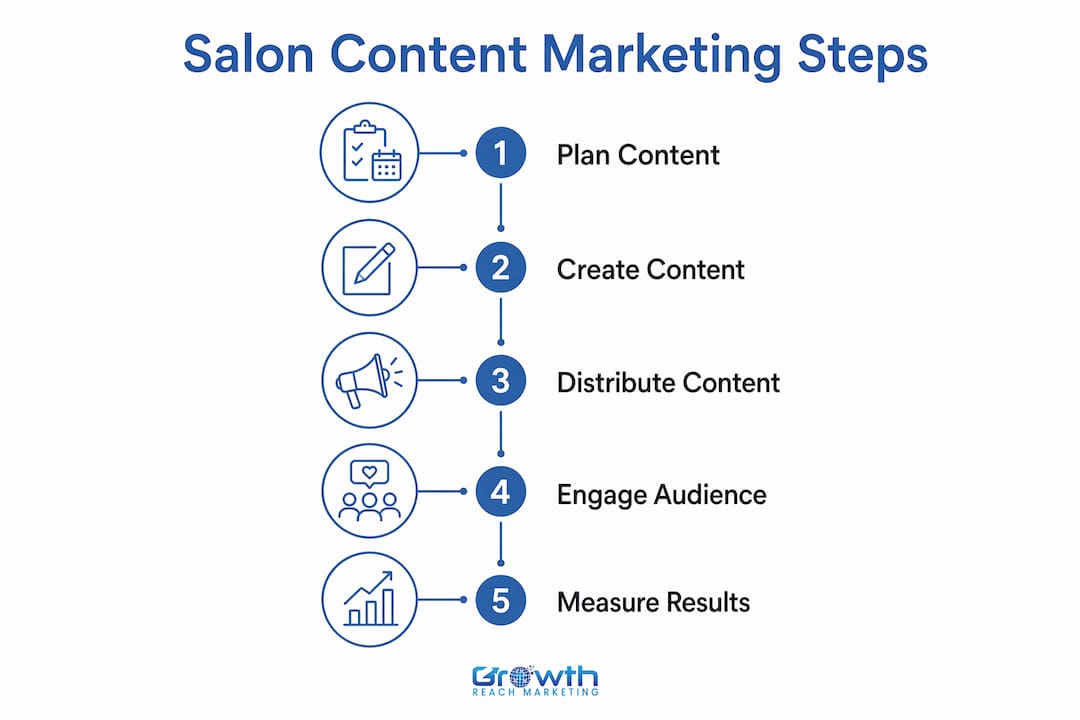
A content marketing system that runs consistently is worth more than a viral post that happens once. The goal is a repeatable process that produces content weekly without burning you out.
Follow these steps to build yours:
-
Define your who, where, what, and when. Who is your ideal client? Where do they spend time online? What questions do they have before booking? When will you post? Write these answers down. This is your marketing plan.
-
Choose two to three channels and commit. Google Business Profile and Instagram are the right starting point for most salons. Add email once you have a list of 100 or more subscribers. Explore salon email marketing tactics once that channel is ready to scale.
-
Develop three to five signature content themes. Examples: transformation Tuesday photos, product recommendation posts, client FAQ answers, behind-the-scenes stylist spotlights, and seasonal service promotions. Rotate these themes weekly so you always know what to post.
-
Add a call to action to every single piece of content. Not every CTA needs to be “Book now.” It can be “Save this for your next appointment” or “Tag a friend who needs this.” But every post should move the reader one step closer to your booking page.
-
Commit to 90 days before evaluating results. Content marketing builds momentum slowly. Most salon owners quit after three weeks because they do not see immediate bookings. The compounding effect of consistent content takes 60–90 days to show up in your analytics.
Pro Tip: Batch your content creation. Spend two hours on the first Sunday of each month shooting photos and writing captions for the next four weeks. You will post more consistently and with less daily stress.
Key takeaways
Salon content marketing works because it builds trust before a client ever contacts you, and trust is what converts browsers into booked appointments.
| Point | Details |
|---|---|
| Content marketing vs. social posting | Website content ranks on Google for months; social posts disappear within days. |
| The 40-40-20 framework | Split content into 40% proof, 40% education, and 20% direct booking calls to action. |
| Channel foundation | Start with Google Business Profile and Instagram before expanding to email and video. |
| Reply speed is a KPI | Responding to inquiries within 30 minutes significantly increases your booking conversion rate. |
| Consistency beats volume | A sustainable weekly system outperforms sporadic bursts of high-volume posting every time. |
What i’ve learned after watching salons struggle with this
Most salon owners I work with are not failing at content creation. They are failing at content strategy. They post beautiful photos, get compliments from existing clients, and wonder why new bookings are not coming in. The issue is almost always the same: no education content, no calls to action, and no system.
The salons that grow fastest are the ones that treat their Google Business Profile like a second website. They add photos weekly, post updates about seasonal services, and respond to every review within 24 hours. That discipline alone drives a measurable lift in calls and clicks, without spending a dollar on ads.
The shift I am watching in 2026 is toward technology-driven personalization. Salons using AI virtual try-on tools on their websites are seeing higher engagement and fewer no-shows because clients arrive already committed to a specific look. That is content marketing doing its job at the highest level.
My honest advice: stop trying to go viral and start trying to be useful. Answer the questions your clients ask every day. Post proof of your work consistently. Tell people how to book. Do that for 90 days and your content will start working harder than any single ad campaign ever could.
— Gerard
Ready to turn your salon content into booked appointments?
Knowing what salon content marketing is and actually building a system that drives bookings are two very different things. Growthreachmarketing works with salons and beauty businesses to build content strategies that rank on Google, attract qualified local clients, and convert traffic into appointments.
If you are running seasonal promotions, your content strategy needs to work in sync with your SEO. Growthreachmarketing’s guide on seasonal SEO for salons explains exactly how to time your content for maximum visibility when clients are actively searching. Explore our full range of salon marketing strategies to find the right fit for your business stage and goals.
FAQ
What is salon content marketing in simple terms?
Salon content marketing is the practice of creating useful, trust-building content such as blog posts, photos, and videos to attract potential clients and guide them toward booking an appointment.
How is content marketing different from paid advertising for salons?
Paid ads like Google Ads stop driving traffic the moment you stop paying. Content marketing builds organic visibility over time, with website content continuing to rank and attract clients for months or years after publication.
How many photos should a salon have on google business profile?
Salons with 100 or more photos on their Google Business Profile receive 520% more calls than those with fewer than 10, making consistent photo uploads one of the highest-return content activities available.
How often should a salon post content?
Three well-planned posts per week across two to three channels is more effective than daily posting without a strategy. Consistency and quality drive results more reliably than volume alone.
What is the fastest way to start content marketing for a salon?
Start by optimizing your Google Business Profile with fresh photos and weekly posts, then build an Instagram presence using the 40-40-20 content framework before expanding to blogs and email.