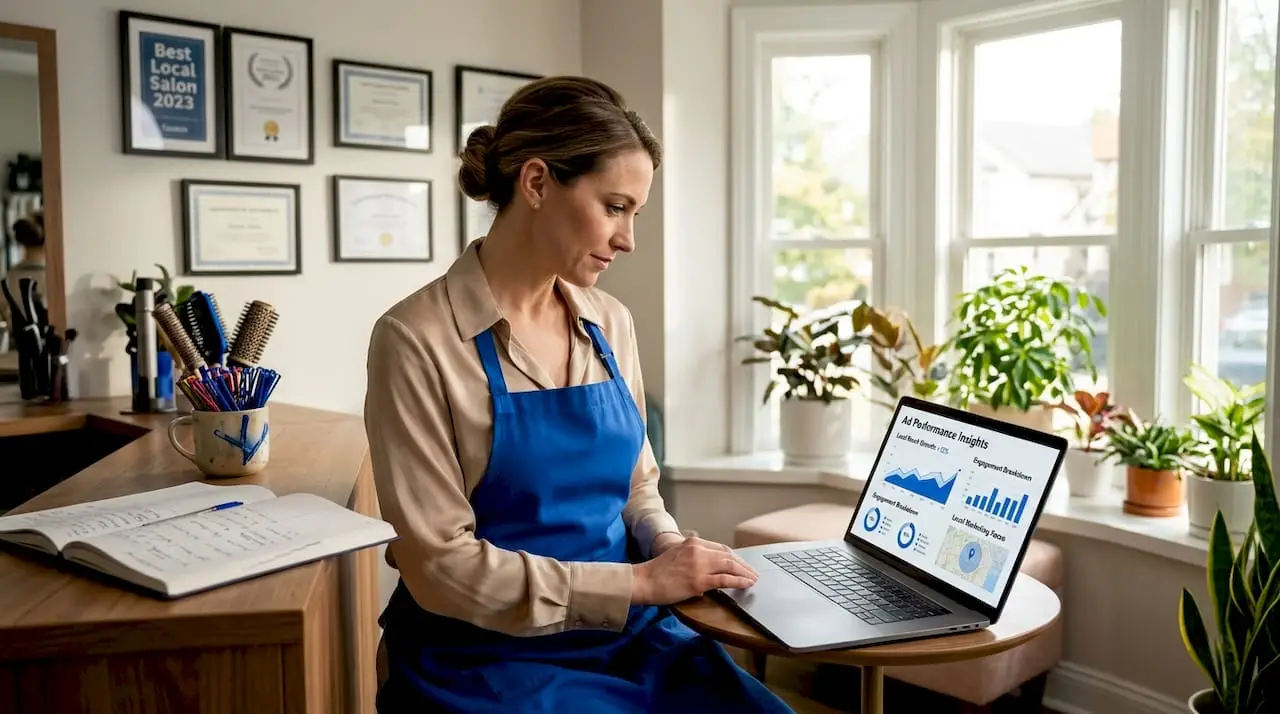
Running ads that actually fill your appointment book is harder than it looks. Most salon and med spa owners spend money on campaigns that get clicks but not clients, because the ads are built for visibility rather than bookings. When you target local clients with salon ads the right way, you stop paying for browsers and start attracting people who are already reaching for their phones to book. This guide walks you through the mindset, the setup, the execution, and the ongoing adjustments that turn your ad budget into a reliable stream of new local appointments.
Table of Contents
- Understanding the local client booking mindset
- Preparing your local salon ads for success
- Executing effective local salon ad campaigns
- Verifying results and optimizing for continuous improvement
- Why most salon ads miss local clients and how to fix it
- How Growth Reach Marketing can help you target local clients effectively
- Frequently asked questions
Key Takeaways
| Point | Details |
|---|---|
| Focus on high-intent local keywords | Use specific service names combined with location and booking calls to target clients ready to book nearby. |
| Promote one core service per campaign | Narrow campaigns focused on a single service with related keywords improve conversions and budget control. |
| Optimize geographic targeting | Set advertising radius based on your salon’s location and typical client travel distance for best ad performance. |
| Use booking-focused landing pages | Clear, simple booking pages tailored to the advertised service reduce user hesitation and boost appointment rates. |
| Track and optimize regularly | Monitor bookings and search terms to adjust ads and exclude irrelevant traffic for sustained campaign success. |
Understanding the local client booking mindset
The first thing to understand about how to target local clients with salon ads is that the people you want are not casually scrolling. They are searching with a specific need, often from a parking lot or their lunch break, and they will book with whoever shows up first and looks trustworthy. Salon searches are fast, local, and urgency-driven, built around “near me” keywords rather than slow, comparative browsing.
This matters because it changes everything about how you write your ads and who you show them to. A person searching “balayage near me open Saturday” is not researching options for next month. She wants an appointment this week. Broad keywords like “hair color” or “beauty salon” attract people at the beginning of a research phase, not the end. You want the end.
Here is what high-intent local salon searches look like in practice:
- “Haircut near me today”
- “Gel nails appointment [city name]”
- “Brazilian blowout open Saturday”
- “Botox consultation near me”
- “Eyebrow wax walk-in [neighborhood]”
These searches tell you exactly what the person wants, when they want it, and where they expect to find it. Your ads need to answer all three signals in the headline.
Clients also prioritize convenience, availability, and trust in that order. If your ad shows up but your booking page is slow, confusing, or asks for too much information, you lose them to the next result. Explore local search strategies that align your whole digital presence with this urgency-first behavior.
Pro Tip: Add time-based language to your ad copy such as “Book today,” “Same-week availability,” or “Open Sundays” to match the urgency your potential clients already feel.
Preparing your local salon ads for success
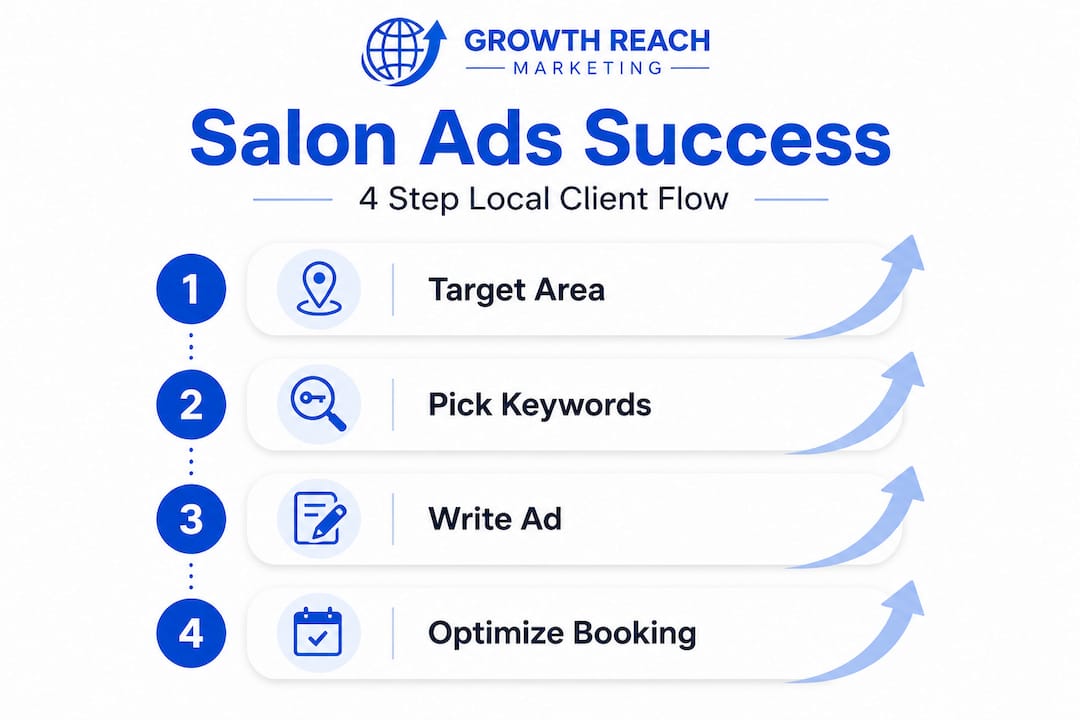
Before you spend a dollar on ads, you need three things locked in: a focused service to promote, the right keywords, and a landing page that does one job. Google Ads work best when focused on one core service with five to ten related high-intent keywords combined with local modifiers. Trying to promote every service in one campaign splits your budget and confuses the algorithm.
Follow these steps to prepare your campaign foundation:
- Pick one primary service. Choose your most profitable or most in-demand service, such as balayage, lash extensions, or lip filler. Build the first campaign entirely around it.
- Research your keywords by category. Use the table below to organize them before you build your ad groups.
- Define your geographic radius. Urban salons typically target 5 to 10 miles. Suburban or rural salons can extend farther, especially for specialty services clients will travel for.
- Build a dedicated landing page. Not your homepage. A single page with the service name, a photo of the result, your location, and one booking button.
- Optimize your Google Business Profile. Correct hours, accurate address, recent photos, and at least 20 reviews mentioning the service you are promoting. Learn more about Google Business Profile optimization to make sure your profile supports your paid campaigns.
- Add negative keywords. Exclude terms like “DIY,” “at home,” “school,” “training,” and “free” to filter out non-buyers immediately.
| Keyword category | Examples | Purpose |
|---|---|---|
| High-intent service | “balayage appointment,” “lash fill booking” | Captures ready-to-book clients |
| Local modifiers | “near me,” “[city name],” “[neighborhood]” | Restricts reach to your area |
| Availability signals | “open Saturday,” “same day,” “walk-in” | Matches urgency of the searcher |
| Negative keywords | “DIY,” “at home kit,” “training course” | Blocks non-buyer traffic |
Check out Google Local Services Ads details for an overview of how the pay-per-lead model can work alongside your standard search campaigns. You can also explore Google Local Services Ads for salons to see how this fits into a broader local advertising plan.
Pro Tip: Before launching, run your landing page through Google’s Mobile-Friendly Test. If it takes more than three seconds to load on mobile, you will lose a significant portion of the high-intent traffic you paid to attract.
Executing effective local salon ad campaigns
With your foundation in place, here is how to build and launch campaigns that actually convert. Google Ads with local search and proximity targeting drive significantly higher intent bookings than broad campaigns, so start there before expanding to social.
Google campaign setup:
- Choose “Search” campaign type and set your location targeting to your defined radius.
- Enable Google Maps ads so your salon appears in map results when someone searches nearby.
- Write headlines that include the service name, your city or neighborhood, and a booking call to action.
- Use ad extensions: location extension, call extension, and booking link if available.
- Set bid adjustments to favor mobile devices, since most local salon searches happen on phones.
Meta Ads setup:
- Choose the “Store Traffic” objective for foot traffic or “Leads” if you use an online booking form.
- Target a 5-10 mile urban radius using “People living or recently in this location” to capture both residents and visitors.
- Layer in behavioral interests: beauty, wellness, personal care, and relevant lifestyle categories.
- Exclude your existing client list from acquisition campaigns so your budget goes toward new clients only.
Here is what your ad creative should include:
- A before-and-after photo or a short video under 30 seconds showing the finished result
- The service name and your location in the first line of copy
- A specific pain point your client feels, such as “Tired of fading color?” or “Ready for lashes that last?”
- One clear call to action: “Book now,” “Claim your spot,” or “See availability”
Pro Tip: For video ads on Meta, show the finished look in the first two seconds. Most people will not watch past that point, so lead with the result rather than the process. Then increase salon foot traffic with Meta Ads by sending that traffic to a frictionless booking page.
Verifying results and optimizing for continuous improvement
Launching your campaigns is not the finish line. The salons that consistently win at local advertising are the ones that review their numbers weekly and make small, data-driven adjustments. Tracking key local metrics like store visits and cost per lead gives you reliable insight into what is working, far beyond surface-level vanity metrics like impressions or page likes.
Here is what to monitor and how to act on it:
- Cost per booking: If this is rising, check your landing page conversion rate before adjusting ad spend.
- Search terms report: Review search terms weekly to identify irrelevant queries draining your budget and add them as negatives.
- Click-through rate (CTR): A CTR below 3% on branded local terms suggests your headline is not matching the searcher’s intent.
- Store visits vs. online bookings: If store visits are high but online bookings are low, your landing page needs work, not your ads.
- Geographic performance: Break down results by zip code or neighborhood to see where your best clients are coming from, then tighten your radius around those areas.
| Metric | Before optimization | After optimization | Action taken |
|---|---|---|---|
| Cost per booking | $48 | $22 | Added negative keywords, improved landing page |
| CTR | 1.8% | 4.3% | Rewrote headlines with local + service specifics |
| Conversion rate | 2.1% | 6.7% | Simplified booking form to name, phone, service |
| Store visits | 12/month | 31/month | Tightened radius, added Maps ad extension |
Respond to every new review promptly, especially the critical ones. Reviews mentioning your specific services feed directly into your local search ranking and build the trust that converts ad clicks into actual appointments. Find more campaign performance optimization tips to keep your results improving month over month.
Pro Tip: Set a recurring calendar reminder every Monday morning to check your search terms report. One hour a week of negative keyword cleanup can reduce wasted spend by 20 to 30 percent over a single month.
Why most salon ads miss local clients and how to fix it
Here is the uncomfortable truth most marketing advice skips: the majority of salon ads are built like brand awareness campaigns for national retailers, not like appointment offers for a local business with 10 open slots this week. Most salon ads assume slow browsing, but real salon clients search fast, decide fast, and book with whoever feels immediately right.
The most common mistake we see is targeting too broad. An ad for “hair services in [state]” is not a local ad. It is a waste. Salon clients do not travel 40 miles for a haircut. They book the closest option that looks good and has availability. When your targeting is too wide, you pay for clicks from people who will never walk through your door.
The second mistake is generic messaging. “Best salon in town” means nothing to someone searching for a specific service right now. “Balayage starting at $120, book this week in [neighborhood]” means everything. Specificity is the difference between an ad that gets scrolled past and one that gets clicked and booked.
The third mistake is treating the landing page as an afterthought. A mobile user who clicks your ad and lands on a homepage with a navigation menu, three pop-ups, and no visible booking button will leave in under five seconds. Your landing page should have one job: confirm the service, show the result, and make booking take less than 60 seconds.
Think of every ad as an immediate appointment offer, not a brand introduction. The local service ad strategies that consistently outperform are the ones built around urgency, specificity, and a frictionless path from click to confirmed booking.
How Growth Reach Marketing can help you target local clients effectively
Knowing the strategy is one thing. Building and managing campaigns that actually deliver consistent bookings is another, and it takes time most salon owners do not have.
At Growth Reach Marketing, we specialize in local salon ad services built specifically for salons and med spas. We handle keyword research, geographic targeting, landing page design, and ongoing campaign adjustments based on real booking data, not guesswork. Our team sets up custom ad campaign management that integrates with your Google Business Profile and review management so every part of your local presence works together. If you are ready to stop guessing and start filling your calendar, boost salon bookings with a team that knows exactly what local clients need to see before they hit “book now.”
Frequently asked questions
What keywords should I target in my salon ads to attract local clients?
Focus on high-intent keywords that combine your core service with local cues and booking language, such as “haircut near me today” or “manicure appointment [city],” to reach clients who are already ready to book rather than still browsing options.
How far should I set my geographic radius when targeting local salon ads?
Urban salons perform best targeting within a 5 to 10 mile radius, while suburban or rural salons can extend farther depending on how far clients typically travel for your specific services.
Should I use Google Local Services Ads for my salon?
Yes. Google Local Services Ads appear at the top of search results with a “Google Guaranteed” badge and use a pay-per-lead pricing model, making them one of the most cost-effective options for building trusted local visibility and driving bookings.
What type of Facebook ad works best for local salons?
Simple coupon ads and short videos under 30 seconds focused on a single service consistently outperform complex multi-service campaigns, especially when paired with a narrowly targeted local audience and a dedicated booking page.
How important is my Google Business Profile for local salon ads?
Extremely important. Review quantity and quality on your Google Business Profile directly boost your visibility in local map pack results and build the credibility that turns ad clicks into confirmed appointments.