Most salon owners are talented at their craft but find social media genuinely confusing. You post a gorgeous color transformation, get a handful of likes, and wonder why your chair isn’t filling up. The problem usually isn’t your work. It’s the common salon social media mistakes quietly killing your reach before clients ever see what you can do. Only 55% of small businesses have a documented social media strategy, which means nearly half are just guessing. This article breaks down exactly where salons go wrong and what to do instead.
Table of Contents
- Lack of a clear social media strategy and inconsistent posting
- Ignoring platform differences and spreading too thin
- Common content pitfalls: inconsistent visuals and missing client consent
- Underutilizing engaging content formats like process videos and ignoring Pinterest
- Summary comparison of common salon social media mistakes
- Why focusing on authentic engagement beats chasing trends
- How Growth Reach Marketing supports salons avoiding social media mistakes
- Frequently asked questions
Key Takeaways
| Point | Details |
|---|---|
| Consistent strategy is vital | Having a documented social media plan with clear posting goals improves engagement and effectiveness. |
| Focus on key platforms | Tailor your content to 1-2 platforms your salon’s clients use most for better results and less burnout. |
| Visual consistency builds trust | Use a fixed photo station and consistent lighting for before-and-after photos to avoid seeming fake. |
| Engaging content outperforms static | Videos showing the process of transformation gain more engagement than just after photos. |
| Authentic engagement matters | Responding to comments and interacting meaningfully grows loyal followers and boosts algorithm visibility. |
Lack of a clear social media strategy and inconsistent posting
This is where most salon social media blunders begin. Without a written plan, posting becomes reactive. You share something when you remember, skip weeks when you’re slammed, and never build the kind of consistent presence that turns followers into bookings.
Only 55% of small businesses have a dedicated social media strategy document in 2026. That gap shows up in erratic posting schedules, vague content, and zero measurable goals. A strategy document doesn’t need to be complicated. It should answer three questions: Who are you talking to? What do you want them to do? What content will move them there?
For posting frequency, the numbers matter. Salons should post 3 to 5 times weekly on Instagram and Facebook, with TikTok requiring daily or every-other-day content to maintain algorithm favor. That sounds like a lot, but a content calendar makes it manageable. Plan your content in weekly batches, assign themes to each day (client transformations on Monday, tips on Wednesday, behind-the-scenes on Friday), and you’ll never stare at your phone wondering what to post.
Here’s what a basic salon content strategy covers:
- Audience definition: New clients in a specific zip code? Brides? Color correction seekers?
- Content pillars: Before-and-afters, educational tips, team spotlights, seasonal promotions
- Posting schedule: Specific days and times based on when your audience is online
- Engagement goals: Response time targets, comment reply habits, story interaction frequency
- Monthly review: What performed well, what flopped, what to adjust
You can explore social media content planning tips to build a framework that fits your salon’s specific schedule and team size.
Pro Tip: Batch your content creation on one day per week. Shoot five to seven pieces of content in a single session, then schedule them out. This alone eliminates most of the inconsistency that hurts salons.
Ignoring platform differences and spreading too thin
One of the most frequent salon posting errors is treating Instagram, Facebook, TikTok, and Pinterest like they’re the same tool. They’re not. Each platform has a different audience mindset, content format, and algorithm behavior. Posting identical content everywhere is a common mistake that leads to burnout and poor results across the board.
The smarter move is to pick one or two platforms where your ideal clients actually spend time, master those, and expand only when you have the capacity.
Instagram and TikTok excel at transformations and trending styles. Facebook drives local community engagement. Pinterest attracts clients who are actively searching for inspiration and are much closer to booking. Each platform deserves its own content approach.
| Platform | Best content type | Primary audience | Posting frequency |
|---|---|---|---|
| Reels, before-and-afters, Stories | Style-conscious adults 25-44 | 4-5x per week | |
| TikTok | Process videos, trending audio | Younger clients, trend seekers | Daily or every other day |
| Local promotions, reviews, events | Community-focused, 35+ | 3-4x per week | |
| Inspiration boards, style guides | Style researchers, brides | 5-10 pins per week |
Here’s what platform-specific content looks like in practice:
- Instagram: A 30-second Reel of a balayage transformation set to trending audio, with a caption that includes your city name and a call to book
- TikTok: A raw, behind-the-scenes clip of foil placement with a voiceover explaining the technique
- Facebook: A post sharing a five-star Google review with a photo and a link to your booking page
- Pinterest: A board titled “Warm Brunette Hair Ideas 2026” with pins linking back to your website
Pro Tip: If you’re just starting out, choose Instagram first. It has the strongest visual discovery features for salons and the most direct path from post to booking link.
For more guidance on choosing social platforms that match your salon’s goals and client base, it’s worth thinking through where your current clients actually discovered you.
Common content pitfalls: inconsistent visuals and missing client consent
Before-and-after photos are the backbone of salon social media content. They’re also where a lot of salons quietly undermine their own credibility. Inconsistent lighting in before-and-after photos makes transformations look fake, even when the results are genuinely impressive. A client’s brain registers the inconsistency before their conscious mind does, and trust erodes.
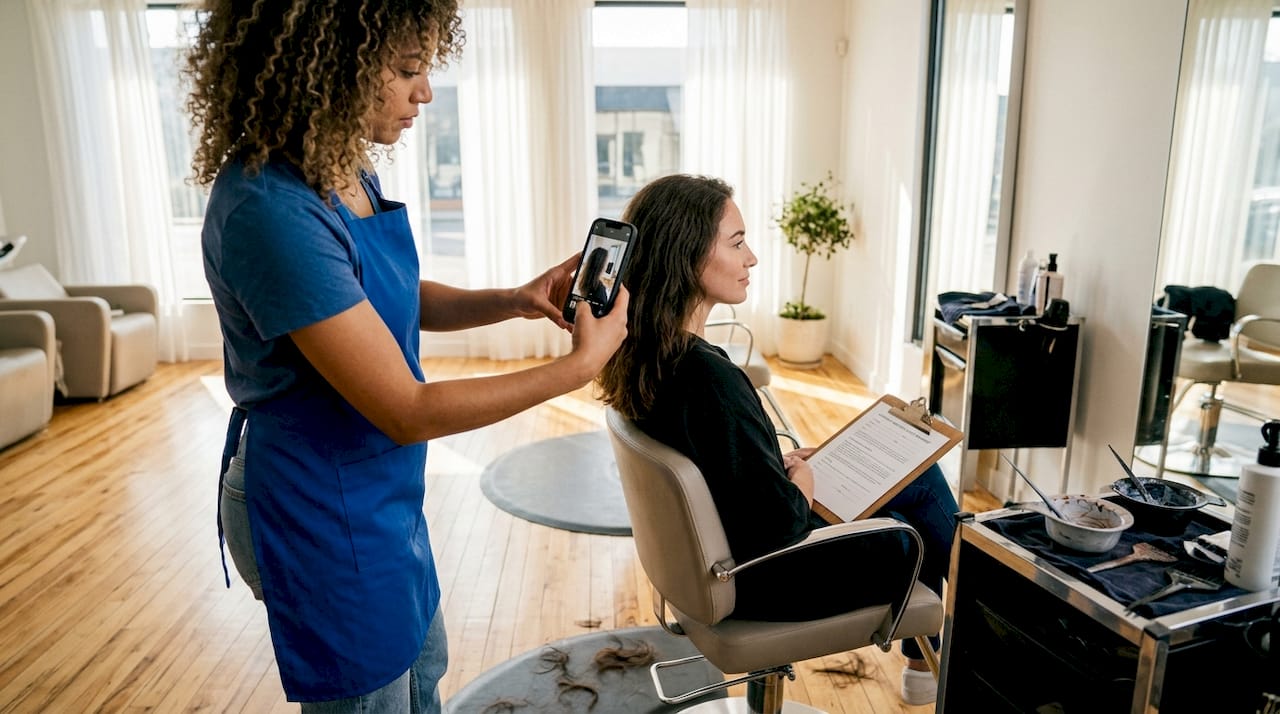
The fix is simpler than most people expect: a dedicated photo station. Pick one spot in your salon with consistent natural or artificial light. Use the same background. Shoot at the same angle every time. This single change makes your feed look professional and your transformations believable.
Here’s a quick checklist for taking better before-and-after photos:
- Lighting: Natural light or a ring light at the same position every time
- Background: Neutral wall or branded backdrop, never a cluttered station
- Angle: Eye level, centered, consistent distance from client
- Camera settings: Same phone, same portrait mode settings
- Timing: Before photo before any product is applied; after photo once styling is complete
The other major issue is consent. Salon teams must collect photo release consent through intake forms before services begin. Posting a client’s photo without explicit permission can result in content removal, complaints, or worse. A simple checkbox on your intake form asking “May we share your photos on social media?” solves this entirely. Make it part of your standard process so it never gets skipped.
For more on creating compelling salon photos that perform well on social media, the approach you use in-salon directly affects what’s possible online.
Pro Tip: Keep a printed photo release form at every station and train your team to ask during the consultation, not after the service. Clients are far more likely to say yes when they’re excited about the upcoming transformation.
Underutilizing engaging content formats like process videos and ignoring Pinterest
Static after photos are the most common content type salons post. They’re also the least engaging format available. Process videos showing the transformation journey get dramatically more engagement than a single finished result photo. The reason is simple: video holds attention longer, and longer attention signals value to the algorithm.
You don’t need a videographer. A phone propped on a ring light stand, capturing the stages of a color service, is enough. Think foil placement, toning, blow-dry, and the final reveal. Each stage is its own content opportunity.
Common med spa social media content mistakes mirror this exact issue. Clinics and salons alike lean too heavily on polished final images and skip the process that makes clients trust the work. The process is the proof.
Here’s how to build a process video content strategy:
- Set up your phone at a consistent angle before the service begins
- Capture 10 to 20 second clips at each major stage: consultation, application, processing, rinse, style
- Edit in a free app like CapCut, trimming clips to 30 to 60 seconds total
- Add trending audio from Instagram or TikTok’s built-in music library
- Write a caption that explains what technique was used and invites questions
Pinterest is the other major missed opportunity. Ignoring Pinterest leaves salons invisible to clients who are actively searching for styles. Unlike Instagram posts that disappear from feeds within 24 to 48 hours, Pinterest pins can drive traffic for months or even years. A well-optimized pin titled “Lived-in Blonde Balayage for Fine Hair” can bring in booking inquiries long after you’ve forgotten you created it.
For engaging social media content ideas that go beyond the standard after photo, mixing formats is the fastest way to improve reach without posting more often.
Summary comparison of common salon social media mistakes
Understanding each mistake individually is useful. Seeing them side by side helps you decide what to fix first. Consistency in posting maintains engagement and algorithm favor without overwhelming your team, which is why it appears at the top of this table.
| Mistake | Why it happens | Impact on salon | Fix |
|---|---|---|---|
| No strategy document | Posting feels intuitive, planning feels like extra work | Random content, no measurable growth | Write a one-page strategy with goals, themes, and schedule |
| Inconsistent posting | Busy schedule, no content calendar | Algorithm deprioritizes your account | Batch content weekly, schedule in advance |
| Same content on all platforms | Easier to cross-post than customize | Low engagement, platform mismatch | Tailor format and message per platform |
| Poor lighting in photos | No dedicated photo station | Transformations look unconvincing | Set up a fixed photo station with consistent light |
| Missing client consent | Overlooked in the rush of service | Content removal, client complaints | Add photo release checkbox to intake form |
| Only posting after photos | Feels like the most polished option | Low engagement, missed algorithm signals | Add process videos and Pinterest pins |
For a deeper look at common social media errors and how they compound over time, the table above is a useful starting point for your next team review.
Why focusing on authentic engagement beats chasing trends
Here’s the take most marketing articles won’t give you: the salons that grow fastest on social media are rarely the ones with the most posts or the most viral moments. They’re the ones that reply to every comment, respond to every DM, and make followers feel like they’re talking to a real person.
Replying to comments on Instagram can boost engagement by around 21%. That’s not a small number. And it costs nothing but a few minutes a day. Yet most salons ignore their comment sections entirely, treating social media as a broadcast channel instead of a conversation.
The obsession with trending audio and viral formats is understandable. A trending sound can give a post a short-term boost. But a salon that replies thoughtfully to “What color is this?” and “How long does this last?” builds something the algorithm can’t manufacture: trust. That trust is what turns a follower into a first-time client and a first-time client into a loyal one.
This matters especially when you think about how to improve salon social media over the long term. Short-term spikes from trends don’t compound. Consistent engagement does. Clients who feel heard and seen in your comment section are far more likely to tag friends, share your posts, and book without needing a discount to push them over the edge.
The brands we see win in this space treat their social media presence like a front desk, not a billboard. They answer questions fast, thank people for compliments, and handle concerns publicly with professionalism. That behavior builds client relationships that no amount of viral content can replicate.
How Growth Reach Marketing supports salons avoiding social media mistakes
Knowing what to fix is one thing. Having the time and expertise to fix it is another. Most salon owners are fully booked behind the chair, which means social media strategy falls to the bottom of the list until it becomes a real problem.
Growth Reach Marketing works directly with salons to build social media systems that run without requiring you to become a content creator. That means a written strategy tailored to your client base, photo and video content optimized for the platforms where your clients actually book, and ongoing engagement management that keeps your community growing. Our social media marketing services are built specifically for beauty and wellness businesses that need results, not just reach. If you’re ready to stop guessing and start growing, explore our custom salon marketing plans or visit Growth Reach Marketing to see how we can build a system that fills your books.
Frequently asked questions
How often should a salon post on social media to stay effective?
Salons should post 3 to 5 times weekly on Instagram and Facebook, and daily or every other day on TikTok to maintain consistent engagement and stay in favor with each platform’s algorithm.
Why is consistent before-and-after photo lighting important for salons?
Inconsistent lighting makes transformations look unconvincing even when the results are real, which erodes client trust before they ever reach out to book.
What is the best way to get client permission for posting photos?
Include a photo release checkbox in your intake form before services begin so consent is explicit, documented, and collected before the session starts rather than awkwardly asked for afterward.
Why should salons focus on fewer social platforms rather than all at once?
Being everywhere with identical content causes burnout and produces weak results on every platform; mastering one or two channels where your ideal clients spend time delivers far better engagement with a workload your team can actually sustain.