

Most beauty brands treat content as decoration. Post a glowing skin shot, write a caption about “confidence,” and call it a day. But understanding what is a beauty content strategy at a functional level changes everything. It is a planned system of content pillars, audience mapping, and funnel-stage intent, designed to build trust, generate qualified interest, and convert browsers into paying clients. Documented content strategies deliver nearly 3x higher ROI than undocumented approaches. That gap is not a coincidence. It is what separates brands that grow from brands that simply post.
Table of Contents
- Key Takeaways
- What is a beauty content strategy: the foundational framework
- Mapping content pillars to the customer journey
- Creator authority as a strategic asset
- Optimizing for AI-driven search and discovery
- Building a scalable beauty content calendar
- My honest take on where beauty brands go wrong
- How Growthreachmarketing helps beauty brands grow with content
- FAQ
Key Takeaways
| Point | Details |
|---|---|
| Strategy beats aesthetics | A beauty content strategy is a system mapped to business goals, not just a feed of pretty visuals. |
| Pillars guide all content | Defining 4 to 6 content pillars tied to funnel stages prevents random posting and builds authority. |
| Creator partnerships compound | Always-on creator relationships with 3 to 10 trusted voices outperform short burst campaigns every time. |
| AI discovery is now a channel | Formats like tutorials, comparisons, and reviews are increasingly the source material AI platforms cite. |
| Calendars make strategy real | A living content calendar with seasonal planning and the 70-20-10 rule turns strategy into repeatable execution. |
What is a beauty content strategy: the foundational framework
At its core, a beauty content strategy is a documented plan that defines what your brand publishes, for whom, and why, across every stage of the customer journey. The industry term for this is content marketing strategy, and beauty brands that treat it as a formal discipline rather than an afterthought consistently outperform those that improvise.

Sound strategy planning answers three questions: Why are you creating this content (your goals), Who is it for (your audience), and How will you deliver it differently (your brand perspective). Getting these three right before you shoot a single video or write a single post eliminates the most common failure mode in beauty marketing: content that looks great but converts nobody.
Your goals need to connect directly to business outcomes. Are you trying to increase booking rates for a specific treatment? Grow an email list? Build authority in the skincare education space? Each goal requires a different content mix, different formats, and different success metrics.
Audience definition in beauty goes beyond demographics. You need to understand where each segment sits in their decision journey. A customer discovering your brand for the first time needs education. Someone comparing you to a competitor needs proof. Someone who already purchased needs community and loyalty content.
Here is what strong foundational strategy covers:
- Business goals: Tied to revenue, bookings, or brand reach, not vanity metrics
- Audience profiles: Built around intent and decision stage, not just age and gender
- Brand perspective: The unique point of view that makes your content worth following instead of skipping
- Content formats: Matched to platform behavior and audience preference, not just production capability
Pro Tip: Write your brand perspective as a one-sentence statement that no competitor could claim. If another brand could post your content under their logo without it feeling off, your perspective is not defined yet.
Mapping content pillars to the customer journey
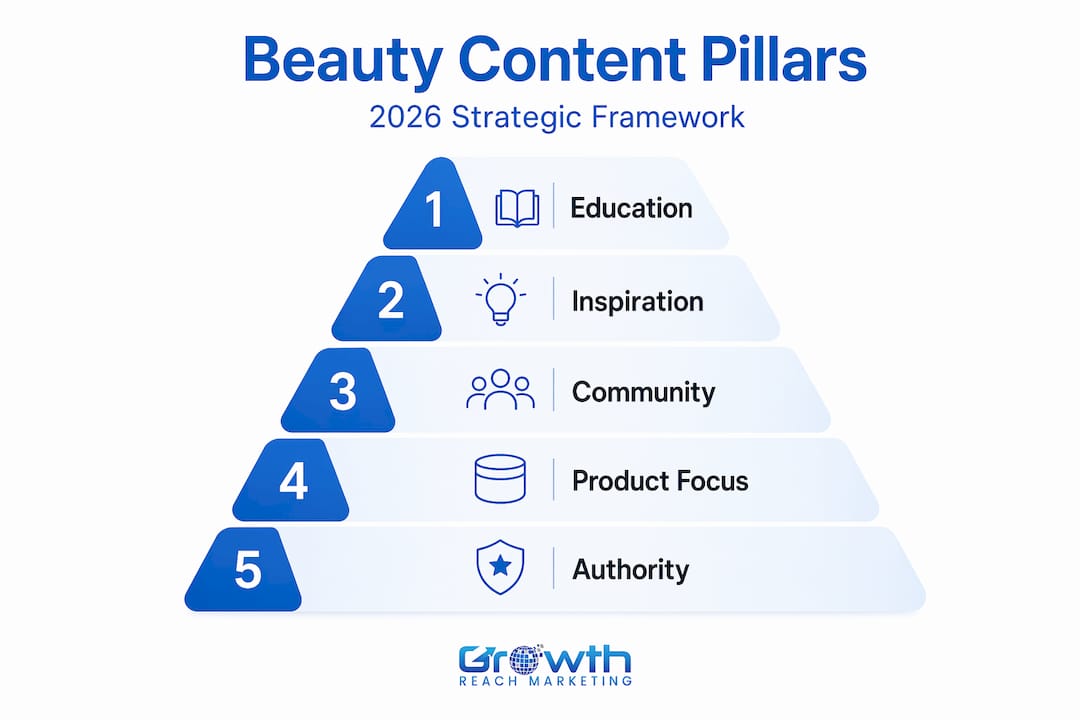
Content pillars are the recurring themes your brand publishes around. In beauty, most brands intuitively choose pillars like “skincare tips” or “product showcases.” But that framing is too broad to be useful. Pillars should address specific customer problems with proof assets like demos, before and afters, and expert reviews, not just inspiration imagery.
Effective beauty-specific pillars typically fall into five categories: education, inspiration, community, product focus, and behind-the-scenes. But the real skill is in knowing what intent each pillar serves at each funnel stage.
| Funnel stage | Content intent | Pillar examples | Best formats |
|---|---|---|---|
| Awareness | Educate and attract | Skin condition explainers, ingredient guides | Short video, blog, Reels |
| Consideration | Build trust and compare | Before and after reviews, product demos | Long-form video, carousel posts |
| Conversion | Reduce friction | Testimonials, FAQs, booking content | Email, landing page, Stories |
| Retention | Reward and deepen loyalty | Community highlights, how-to tutorials | Newsletter, members-only content |
The biggest mistake beauty brands make is using the same content intent at every funnel stage. You cannot post product promotion at someone who has never heard of your brand and expect them to convert. That is not a content problem. It is a strategy problem.
Pro Tip: Audit your last 30 posts and tag each one by funnel stage. Most brands discover 80% of their content lands in either awareness or conversion, with almost nothing in the consideration and retention stages where real trust gets built.
For beauty brands working in content marketing for clinics and salons, the consideration stage is especially underdeveloped. Detailed treatment explainers, practitioner credentials, and client journey stories are exactly what converts a curious visitor into a booked appointment.
Creator authority as a strategic asset
The creator economy in beauty has matured. What worked in 2021, which was sending a product to 50 influencers for a single sponsored week, no longer builds sustainable discoverability or trust. The shift is toward fewer, longer, deeper partnerships.
Shifting from 50 creators in one week to 3 to 10 creators with ongoing partnerships produces compounding authority rather than a single traffic spike. This model, often called always-on creator strategy, treats creators as long-term editorial contributors rather than one-time media buys.
Different creator tiers serve different strategy goals:
- Mass-reach creators (1M+ followers): Drive awareness and cultural moment alignment, but rarely build purchase trust alone
- Specialist creators (50K to 300K): Dermatologists, cosmetic chemists, and skin therapists who publish in-depth content build credibility that general beauty influencers cannot replicate
- Micro and nano creators (1K to 50K): High engagement rates and niche community trust, particularly effective for local service businesses like clinics and salons
- Editorial writers and Substack contributors: Increasingly important as long-form written content becomes a primary source material for AI discovery
Long-form reviews, YouTube deep-dives, and Substack educational content are now among the formats most favored by AI-driven discovery platforms. When someone asks an AI assistant for the best facial treatment for sensitive skin, it surfaces content that has demonstrable depth and source credibility. A 30-second Reel does not make that cut.
Creator partnerships should include clear performance frameworks. Track not just reach and engagement but also search impressions generated by the content, direct traffic to brand pages, and whether the creator’s content gets cited or shared in broader editorial contexts.
Optimizing for AI-driven search and discovery
The era of publishing high volumes of blog posts to chase keyword rankings is losing its edge. Not because SEO is dead, but because the definition of winning has changed. Traffic from AI discovery engines converts at three times the rate of traditional search traffic. The reason is intent alignment: people asking AI tools are further along in their decision process.
This changes how you think about format and purpose when creating beauty content. Promotional posts optimized for clicks do not get cited by AI. What does get cited is authoritative, structured, helpful content in formats like:
- Comparison guides (“Retinol vs. Bakuchiol: which works better for sensitive skin?”)
- Tutorial articles with clear step-by-step structure
- Review-style content with real user experiences and named outcomes
- Expert explainers that cite sources and demonstrate credential authority
“Modern content strategy must prioritize engagement and relevance over volume and rankings to succeed in the AI search era.” — Content Marketing Institute
Distribution matters as much as creation. Your content needs to live where your audience already spends time. That means not just your owned blog or Instagram feed but also YouTube, third-party review sites, partner publications, and long-form platforms. Understanding beauty industry content marketing as a multi-channel system rather than a single-feed approach is what separates brands that get cited from those that get ignored.
Track success with metrics that reflect the new model. Time on page, scroll depth, return visits, AI referral traffic, and content-specific conversion rates tell you more than raw page views ever could.
Building a scalable beauty content calendar
A beauty content strategy without a calendar is a vision without execution. The calendar is where strategy becomes real work, and the brands that stay consistent are the ones who treat it as a living document rather than a one-time planning exercise.
Here is a practical sequence for building one that actually scales:
- Map your key dates first. Seasonal campaigns, product launches, industry events, and cultural moments should anchor the calendar before anything else fills it.
- Apply the 70-20-10 rule. Seventy percent of content delivers value and education, 20% curates or repurposes third-party content, and 10% is direct promotion. Most beauty brands invert this ratio and then wonder why engagement is low.
- Batch your content production. Film multiple videos in a single session. Write three blog posts in one focused block. Batching cuts production time by 40 to 60 percent without sacrificing consistency.
- Schedule weekly performance reviews. Which posts drove traffic, saves, or bookings? Use that data to adjust the next month’s plan. Adaptive calendars that respond to performance data consistently outperform static ones.
- Automate distribution where you can. Scheduling tools, email automation, and workflow templates reduce the manual overhead that causes most brands to fall off their publishing cadence.
Pro Tip: Reserve 10 to 15% of your monthly content slots as “reactive.” These are open slots you fill based on trending topics, client questions, or platform algorithm shifts. Brands that plan everything six weeks out often miss the moments that generate the highest organic reach.
Consistency matters more than volume. One high-quality, well-targeted post per week across the right channels outperforms seven mediocre daily posts every time.
My honest take on where beauty brands go wrong
I have worked with beauty brands ranging from single-location salons to multi-product skincare lines, and the pattern I keep seeing is the same. Brands invest heavily in photography, video production, and influencer sends. They build a stunning Instagram feed. And then they wonder why conversions are flat.
The problem is almost never the content quality. The problem is that the strategy underneath it has no spine. There are no defined pillars, no funnel stage mapping, and no distinction between content that educates and content that sells. Everything gets posted with the same promotional energy, and audiences tune it out.
What I have found actually works is treating your content strategy like a product. You define the customer, the problem it solves, the proof that it works, and the moment you deliver it. Creator partnerships built on that foundation produce authority. Calendars built on that foundation produce momentum. The brands that win in 2026 are not the ones with the biggest budgets or the most followers. They are the ones who built social proof systems into their content from day one and stayed consistent long enough for that authority to compound.
Aesthetics still matter in beauty. But strategy is what makes aesthetics profitable.
— Gerard
How Growthreachmarketing helps beauty brands grow with content
At Growthreachmarketing, we work directly with salons, aesthetic clinics, and beauty brands to build the kind of content-driven marketing systems described throughout this article. That includes everything from audience mapping and content pillar development to Google Ads campaigns built specifically to convert beauty-industry traffic into booked appointments.
If your brand is investing in content but not seeing measurable returns in leads or bookings, the issue is almost always structural, not creative. We help you diagnose what is missing, build a scalable plan, and execute it with the kind of consistency that compounds over time. Whether you need a complete content strategy overhaul or a targeted paid media campaign to accelerate results, our team brings the depth and industry focus your growth requires. Reach out to Growthreachmarketing to explore what a smarter beauty marketing strategy looks like for your business.
FAQ
What is a beauty content strategy?
A beauty content strategy is a documented plan that defines what content a brand creates, for which audience segment, and at which stage of the customer journey. It connects content production directly to business goals like bookings, brand authority, and client retention.
How many content pillars should a beauty brand have?
Most beauty brands perform best with four to six content pillars that map to distinct customer needs and funnel stages. Having fewer prevents dilution while having more than six creates inconsistency and makes execution harder to maintain.
Why does creator strategy matter for beauty content in 2026?
Always-on creator partnerships with 3 to 10 specialists build compounding authority and AI discoverability over time, which short burst campaigns cannot replicate. Long-form educational content from trusted creators is increasingly what AI platforms surface in response to beauty-related queries.
How does AI search change beauty content planning?
AI discovery platforms favor review-style, comparison, and tutorial formats over promotional content. Content that drives AI-referred traffic converts at significantly higher rates than traditional search traffic, making format and depth more important than post frequency.
What is the 70-20-10 rule in a beauty content calendar?
The 70-20-10 rule allocates 70% of content to educational or value-driven posts, 20% to curated or repurposed content, and 10% to direct promotion. This ratio keeps audiences engaged without burning trust through over-promotion.